- Home
- Online Doctor
- Weight Loss
- Mounjaro Weight Loss Medication
Mounjaro Weight Loss Medication
Am I eligible?
Mounjaro® is a prescription only medication, not personal preference. It may be suitable for adults with a body mass index (BMI) of 30 or above, or for adults with a BMI of 27 or above who also have a weight-related health condition such as high blood pressure, abnormal cholesterol levels, or type 2 diabetes.
Eligibility is assessed through a medical consultation, which looks at your health history, current medications, previous weight-loss attempts, and overall suitability for treatment. Meeting BMI criteria alone does not guarantee that Mounjaro will be prescribed, as safety and clinical appropriateness must always come first.

How is Mounjaro® Taken?
Mounjaro® is taken once a week as a small injection under the skin, usually in the abdomen, thigh, or upper arm. Treatment starts at a low dose and is gradually increased over several weeks. This gradual dose increase is important, as it helps the body adjust and reduces the likelihood of side effects.
Most people work up to a maintenance dose over time, although dose adjustments may be made depending on how well the medication is tolerated and how each individual responds. Your prescriber will guide you through this process and review progress during treatment.
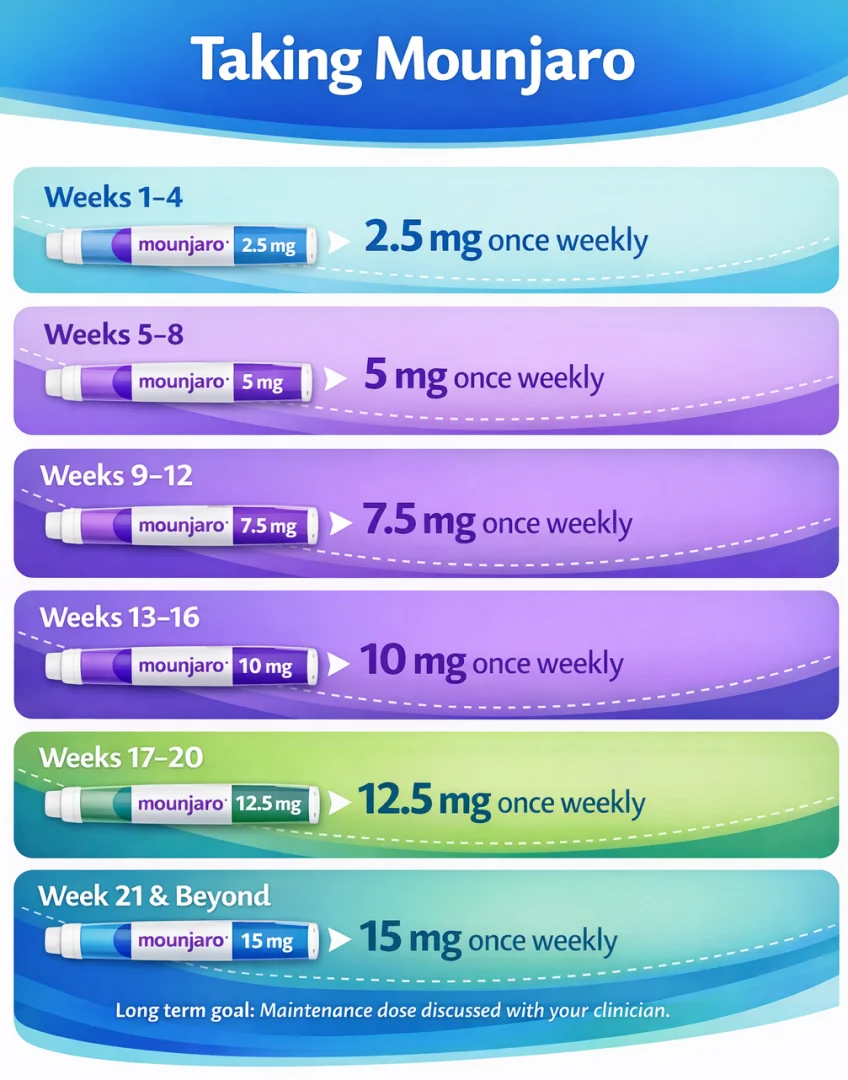
Your Mounjaro® treatment starts at a low dose to help your body adjust, with gradual increases every four weeks until you reach the maintenance dose.
Expected Weight Loss and What to Realistically Expect?
Clinical trials show tirzepatide can deliver 15–22.5% body weight loss over 72 weeks
Mounjaro® (tirzepatide) is a clinically proven treatment for weight management, with substantial results demonstrated in large-scale medical trials.
Clinical Outcomes
In the pivotal SURMOUNT-1 trial, patients receiving tirzepatide achieved:
Up to 22.5% average body weight reduction at the 15 mg dose [1]
Approximately 15–20% weight loss across commonly prescribed maintenance doses [2]
Results observed over 72 weeks (approximately 16–18 months)
This compares to ~2–3% weight loss in placebo groups, highlighting a significant treatment effect.
What This Means in Practice
Weight loss varies by individual, but typical outcomes include:
100 kg → approximately 15–22 kg reduction
90 kg → approximately 13–20 kg reduction
Outcomes depend on adherence, dose escalation, and supportive lifestyle measures including nutrition and activity.
Who Should Not Take Mounjaro® (Tirzepatide)?
Mounjaro® (tirzepatide) is not suitable for everyone. You should not use Mounjaro if you are allergic to tirzepatide or any of the ingredients in the medication. This is the formal contraindication stated in the EMA product information and patient leaflet. [3]
In addition, Mounjaro® for weight management should not be used in children and adolescents under 18 years of age, as safety and efficacy have not been established in this group for weight management. [3]
Speak to a Clinician Before Starting Mounjaro. A clinician should assess suitability before treatment if any of the following apply to you:
- You are pregnant, planning a pregnancy, or may become pregnant. Tirzepatide is not recommended during pregnancy, and the EMA states it should be discontinued at least 1 month before a planned pregnancy.
- You are breastfeeding or planning to breastfeed. The leaflet advises discussing this with your clinician before starting or continuing treatment.
- You have severe problems with food digestion, including severe gastroparesis. Tirzepatide has not been studied in patients with severe gastrointestinal disease and should be used with caution.
- You have a history of pancreatitis.
- You have diabetic retinopathy or diabetic macular oedema, or a history of significant diabetic eye disease.
- You have kidney problems, particularly if you are at risk of dehydration from nausea, vomiting or diarrhoea.
- The product information notes that dehydration may reduce kidney function, and experience in severe renal impairment is limited.
- You have liver disease, particularly severe hepatic impairment, where clinical experience is limited.
- You have gallstones, gallbladder inflammation, or other gallbladder concerns. Gallbladder-related events, including gallstones and inflammation of the gallbladder, are recognised adverse effects and may require further assessment.
What to eat when on GLP1 medication?
A key part of your weight loss journey is diet. While weight loss medication will reduce the “food noise”, what you eat and drink is incredibly important. Changing your diet is one of the biggest steps you can take on your weight loss journey.

Important Safety Information for Mounjaro
Mounjaro® (tirzepatide) is not suitable for everyone. You should not use Mounjaro® if you are allergic to tirzepatide or any of the ingredients in this medication. This is the formal contraindication listed in the official product information.
Mounjaro® may also not be appropriate for you, or may require careful clinical assessment, if any of the following apply:
You are under 18 years of age for weight management treatment
You are pregnant, trying to become pregnant, or breastfeeding
You have severe digestive problems, including severe gastroparesis
You have a history of pancreatitis
You have diabetic retinopathy or diabetic macular oedema
You have kidney problems, especially if you are at risk of dehydration from nausea, vomiting or diarrhoea
You have liver problems
You have gallbladder problems, including gallstones or gallbladder inflammation
You use insulin or a sulphonylurea, as your risk of low blood sugar may be increased and your treatment may need adjusting
If any of the above apply, Mounjaro may not be suitable. A qualified clinician should review your medical historybefore treatment is prescribed.
Citations
[1] SURMOUNT-1 Trial. 72-week study of adults with obesity using Mounjaro® (tirzepatide 15mg). Individual results vary. Published in the New England Journal of Medicine, this landmark randomised controlled trial evaluated tirzepatide in adults with obesity or overweight without diabetes.
Participants achieved mean weight reductions of up to 22.5%
Higher doses were associated with greater weight loss
Reference:
Jastreboff AM et al. Tirzepatide Once Weekly for the Treatment of Obesity.
N Engl J Med. 2022;387:205–216.
[2] SURMOUNT-3 Trial. This study assessed tirzepatide following an initial lifestyle intervention. Participants achieved an additional ~21% weight reduction after prior weight loss
Demonstrates effectiveness both as a primary and continuation therapy
Reference:
Wadden TA et al. Tirzepatide after Intensive Lifestyle Intervention in Adults with Obesity.
N Engl J Med. 2023.
[3] European Medicines Agency - https://www.ema.europa.eu/en/documents/product-information/mounjaro-epar-product-information_en.pdf
FAQs
How Mounjaro® Works
Mounjaro is a once-weekly dual GIP/GLP-1 receptor agonist. It dials down hunger, slows gastric emptying, and helps regulate blood sugar — so you feel fuller, eat less, and lose weight alongside a reduced-calorie diet and movement.
Proven Benefits
Serious weight loss: Avg −15% to −21% at 72 weeks in adults without diabetes (dose-dependent). New England Journal of MedicinePubMed
Beats semaglutide 2.4 mg head-to-head at 72 weeks (−20.2% vs −13.7%). New England Journal of Medicine+1PubMed
Metabolic wins: Lower waist, BP, lipids; improved glycaemic control.Dosing & Administration
Start 2.5 mg once weekly for 4 weeks, then increase every 4 weeks (5 → 7.5 → 10 → 12.5 → 15 mg) as tolerated. Inject subcutaneously into abdomen, thigh, or upper arm. If you miss a dose, take it within 4 days; otherwise skip and continue your usual day.
Who Should Not Use Mounjaro
Under 18s (not studied)
Pregnant, trying, or breastfeeding — not recommended; use effective contraception (oral methods can be less reliable during initiation and dose increases).
Allergy to tirzepatide or ingredients.
Always tell your prescriber about all medicines you take.Possible Side Effects
Common: nausea, vomiting, diarrhoea/constipation, tummy pain (usually ease as doses step up).
Serious but uncommon/rare: pancreatitis, gallbladder issues, severe allergic reaction — seek urgent help if severe abdominal pain or signs of anaphylaxis. Report side effects via MHRA Yellow Card. PubMedLilly UKExpected Results & Timelines
Appetite drops in weeks 1–4; weight change typically shows in the first month, with steady, clinically significant lossbuilding across months as doses increase. Trial data show sustained results through 72 weeks (and maintenance with ongoing therapy).
Dosing Schedule
Weeks 1–4: 2.5 mg once weekly
Weeks 5–8: 5 mg once weekly
Weeks 9–12: 7.5 mg once weekly
Weeks 13–16: 10 mg once weekly
Weeks 17–20: 12.5 mg once weekly
Week 21 onwards: 15 mg once weekly (max; your prescriber may keep you at a lower maintenance dose) Lilly UK
Your Recently Viewed Items