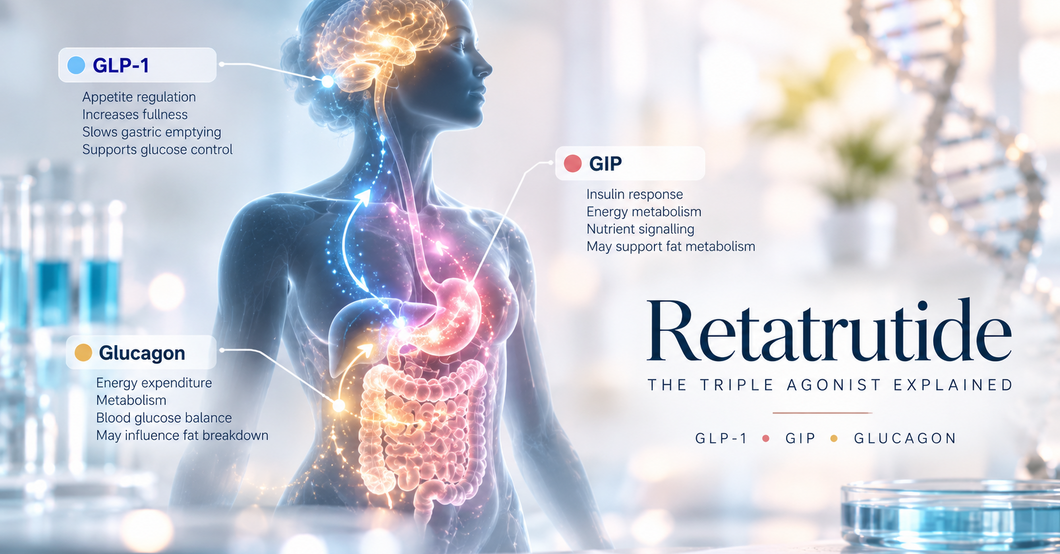
If you've been reading about new developments in weight-management medicine, you may have seen retatrutide described as a “triple agonist.”
But what does that actually mean?
The terminology can sound complicated, especially when names such as GLP-1, GIP and glucagon are added into the conversation.
In this article, we're taking a closer look at the science behind retatrutide and why researchers are interested in a medicine that acts on three different hormone receptors.
First, an important reminder:
Retatrutide remains an investigational medicine and is not currently authorised for public use in the UK.
What does “triple agonist” mean?
An agonist is a substance that activates a particular receptor in the body.
Retatrutide has been designed to activate three different receptors:
GLP-1
GIP
Glucagon
That is where the term triple agonist comes from.
Researchers are studying whether targeting all three pathways at the same time could have effects on appetite, metabolism, blood glucose and energy balance.
What is GLP-1?
GLP-1 stands for glucagon-like peptide-1.
It is a naturally occurring hormone involved in several processes within the body.
GLP-1 signalling can influence:
Feelings of fullness
Appetite
Digestion
Insulin release
Blood glucose regulation
GLP-1 has become particularly well known because several medicines used in diabetes and weight management act on this pathway.
Retatrutide also activates the GLP-1 receptor, but it does not stop there.
What is GIP?
GIP stands for glucose-dependent insulinotropic polypeptide.
Like GLP-1, it is a naturally occurring hormone associated with the body's response to food.
GIP is involved in processes including insulin secretion and energy metabolism.
Researchers have become increasingly interested in whether combining GIP and GLP-1 activity can influence metabolic health in ways that targeting a single pathway cannot.
Retatrutide activates both of these receptors.
What about glucagon?
This is where retatrutide becomes particularly interesting from a research perspective.
Glucagon is another naturally occurring hormone.
It plays an important role in maintaining blood glucose levels and is also involved in energy metabolism.
Retatrutide has been designed to activate the glucagon receptor alongside GLP-1 and GIP receptors.
Researchers are investigating whether this additional pathway could influence energy expenditure and metabolism.
However, the precise balance between potential benefits and risks still needs to be fully understood through clinical research.
Why combine three pathways?
One of the major areas of research in obesity medicine is whether several biological pathways can be targeted at the same time.
Weight regulation is complex.
It isn't controlled by a single hormone or simply by willpower.
Appetite, satiety, energy use, glucose regulation, genetics and many other biological factors can all play a role.
Researchers are therefore studying whether medicines acting on several pathways may produce different effects from medicines acting on only one.
Retatrutide is one example of this newer area of research.
Is retatrutide the same as a GLP-1?
Not exactly.
Retatrutide does activate the GLP-1 receptor, but describing it simply as a GLP-1 medicine does not tell the whole story.
It also activates:
GIP receptors
Glucagon receptors
This is why the more accurate description is a GIP, GLP-1 and glucagon receptor agonist, or triple agonist.
You may occasionally see retatrutide referred to online as a “GLP-3”.
This is not the recognised scientific description of how the medicine works.
Why does the glucagon part matter?
Glucagon is commonly associated with helping the body maintain appropriate blood glucose levels.
But researchers are also interested in its potential effects on energy expenditure and metabolism.
By combining glucagon receptor activity with GLP-1 and GIP activity, researchers are exploring whether there could be a broader metabolic effect.
That does not automatically mean that activating more receptors makes a medicine “better”.
Every additional biological effect also has to be carefully evaluated for safety.
This is why large clinical trials and regulatory assessment are essential.
What are scientists still trying to understand?
Even though clinical research into retatrutide has progressed significantly, there are still important questions to answer.
Researchers and regulators need to understand areas including:
Long-term safety
Side-effect profiles
The effects of different doses
How different patient groups respond
Long-term metabolic outcomes
Whether benefits are maintained over time
The overall balance of benefits and risks
This is why an investigational medicine cannot simply move from promising research into routine clinical use without regulatory review.
Is retatrutide available in the UK?
No.
Retatrutide remains under investigation and is not currently authorised for public use in the UK.
The medicine being studied in clinical trials should not be confused with products being advertised online using names such as “Reta”.
Products obtained through unregulated websites or social-media sellers may not contain what they claim to contain.
Why is there so much discussion about retatrutide?
The interest around retatrutide reflects how quickly the science of obesity treatment is developing.
A few years ago, much of the discussion focused on medicines acting on a single pathway.
Research is now increasingly exploring combinations of different biological targets.
Triple-agonist research represents another stage in that development.
However, scientific interest does not mean a medicine is ready for routine use.
Promising research still needs to go through the appropriate regulatory process.
Mandy's Thoughts
I think this is one of the most interesting parts of the new research around weight management.
For years, people were often told that losing weight was simply about eating less and moving more.
What we're now understanding much better is just how many hormones and biological pathways influence appetite, hunger, fullness and metabolism.
Retatrutide is interesting because researchers are looking at three different pathways together.
But I'm also very conscious that new science can very quickly become hype online.
For me, it's important that we stay curious about developments like this without getting ahead of the evidence.
Research first, regulation next, and then if a medicine is approved, proper clinical assessment.
Frequently Asked Questions
Why is retatrutide called a triple agonist?
Because it activates three hormone receptors: GLP-1, GIP and glucagon.
Is retatrutide a GLP-1?
It activates the GLP-1 receptor, but also acts on GIP and glucagon receptors.
What does glucagon do?
Glucagon is a naturally occurring hormone involved in blood glucose regulation and energy metabolism.
What is GIP?
GIP is a naturally occurring hormone involved in the body's response to food, including insulin secretion and metabolic processes.
Is “GLP-3” the correct name for retatrutide?
No. Retatrutide is more accurately described as a triple GIP, GLP-1 and glucagon receptor agonist.
Is retatrutide available from Shape⁸?
No. Retatrutide remains an investigational medicine and Shape⁸ does not prescribe or supply it.
The Bigger Picture
Retatrutide is part of a broader shift in obesity research.
Scientists are increasingly studying how multiple hormonal pathways interact rather than looking at appetite and metabolism through a single mechanism.
Whether retatrutide eventually becomes an authorised medicine will depend on the full evidence from clinical trials and assessment by medicines regulators.
For now, it remains an interesting area of medical research rather than a treatment available to UK patients.
Interested in licensed treatments available now? Complete an online consultation.
Important Information
This article is provided for general educational purposes only.
It does not advertise, recommend or offer retatrutide.
Retatrutide is an investigational medicine and is not currently authorised for public use in the UK.
Always seek personalised advice from an appropriately qualified healthcare professional.