Wegovy Pill vs Wegovy Injection: Which is best? My Honest Experience After Losing Over Four Stone
Wegovy Pill vs Wegovy Injection UK: My Story, My Experience and What I Wish I’d Known
By Mandy Sandhu, Co-Founder of Shape⁸
If someone had told me ten years ago that I’d one day co-found a medical weight loss clinic, I would have laughed. Back then, I was the woman who had tried every diet, every slimming club and every plan that promised this time would be different. I’d lose a little weight, feel hopeful for a few weeks and then slowly watch it creep back on again. Every time it happened, I blamed myself. I genuinely believed I just didn’t have enough willpower.
Looking back now, I wish someone had told me that weight loss isn’t always about trying harder. Sometimes your body is working against you in ways you don’t fully understand, and sometimes life throws challenges at you that make looking after yourself incredibly difficult.
Living with PCOS
I’ve lived with PCOS for years and, if you have it too, you’ll probably understand exactly what I mean when I say it can feel like your body has its own agenda. I’d watch friends eat what they wanted and seem to lose weight with very little effort, while I felt as though I had to fight for every single pound. It wasn’t just physically exhausting; it was emotionally draining too.
Every failed diet chipped away at my confidence. Instead of questioning whether my hormones were making things harder, I questioned myself. I thought I lacked discipline. I thought I was weak. The truth is, PCOS can make weight management much more challenging, and I wish I’d understood that sooner.
Then Life Changed Forever
There was another chapter in my life that changed everything.
Losing my son is something I will never truly have the words to describe. Grief affects every part of you. It changes the way you think, the way you sleep and the way you cope with everyday life. Looking after my own health became the last thing on my mind, and food became comfort rather than nourishment.
Looking back now, I can see that I was surviving rather than living. At the time, though, I simply felt as though I’d lost myself. If you’ve ever gone through a difficult period in your life and found your health slipping away, I hope you’ll show yourself more kindness than I showed myself.
The Turning Point
Eventually, I reached a point where I knew something had to change. It wasn’t because I wanted to wear a smaller dress or because I wanted compliments. I wanted my energy back. I wanted my confidence back. More than anything, I wanted to feel healthy again.
That was when I started researching medically supervised weight management and learning more about GLP-1 medications. I’ll admit, I was sceptical at first. After years of trying and failing, it was difficult to believe that anything could genuinely help me. But I also knew I couldn’t keep repeating the same cycle and expecting a different result.
My Experience with GLP-1 Medication
My experience with GLP-1 medication changed my life, but probably not in the way most people expect. Yes, I lost over four stone. Yes, I became healthier. Yes, my confidence returned. Those things were wonderful, but they weren’t the biggest changes.
The biggest change happened in my mind.
For years, my thoughts revolved around food. I’d finish one meal and already be thinking about the next. I’d tell myself I was only going to have one biscuit, then feel guilty afterwards. Every Monday became another fresh start that somehow never lasted.
Then, gradually, that constant chatter became quieter.
People often describe this as food noise, and that’s exactly how it felt to me. It was as though someone had finally turned the volume down. Healthy choices didn’t suddenly become effortless, but they no longer felt like a battle every hour of every day. For the first time in years, I felt like I was making decisions instead of simply reacting to cravings.
Losing Over Four Stone
People often ask me what it felt like to lose over four stone. Of course I was delighted with the weight I’d lost. I had more energy, more confidence and I felt healthier than I had in years. But if I’m honest, the scales weren’t the biggest victory.
The biggest victory was getting my life back.
It was walking into a room without worrying about what people thought of me. It was enjoying having photographs taken instead of avoiding the camera. It was feeling comfortable in my own skin again. Those are the moments that stay with you far longer than buying a smaller dress size.
Why We Created Shape⁸
My sisters and I didn’t create Shape⁸ because we wanted to sell weight loss medication. We created it because we knew there had to be a better way to support people. We wanted to build the clinic we wished we’d found ourselves, somewhere people would feel listened to, understood and supported instead of judged.
Behind every enquiry is a person with their own story. It might be someone living with PCOS, someone who’s tried every diet without success or someone who’s quietly lost confidence over the years. I know how that feels because I’ve been there myself, and that’s why every patient who comes to Shape⁸ deserves compassion, honesty and personalised clinical care.
Find out more about Shape⁸.
Why I’m Sharing My Story
If you’ve searched for “Wegovy pill vs Wegovy injection”, “Which weight loss treatment is right for me?” or “Does Wegovy really work?”, you’re probably hoping to find an honest answer rather than another sales page.
That’s why I wanted to write this article. Not to tell you that one treatment is perfect. Not to promise results that nobody can guarantee. But to share my experience, explain what I’ve learnt and help you make an informed decision with the support of a qualified clinician.
If my story helps even one person stop blaming themselves and realise they don’t have to face this journey alone, then writing it will have been worthwhile.
Understanding Wegovy: More Than Just Weight Loss
One of the biggest misconceptions I hear is that Wegovy is a “magic injection” or a quick fix. I understand why people think that because that’s often how it’s portrayed online. The truth is, my experience was very different. Medication didn’t magically change my life overnight, and it certainly didn’t do all the hard work for me. What it did was give me the opportunity to make healthier choices because, for the first time in years, I didn’t feel as though I was constantly battling my own body.
Wegovy belongs to a group of medicines called GLP-1 receptor agonists. They work by mimicking a hormone that our bodies naturally produce, helping many people feel fuller for longer and reducing appetite. For me, the biggest difference wasn’t simply eating less. It was finally having some peace from the constant thoughts about food. If you’ve ever found yourself planning your next meal while you’re still eating the current one, or promising yourself that “Monday will be different,” you’ll understand exactly what I mean.
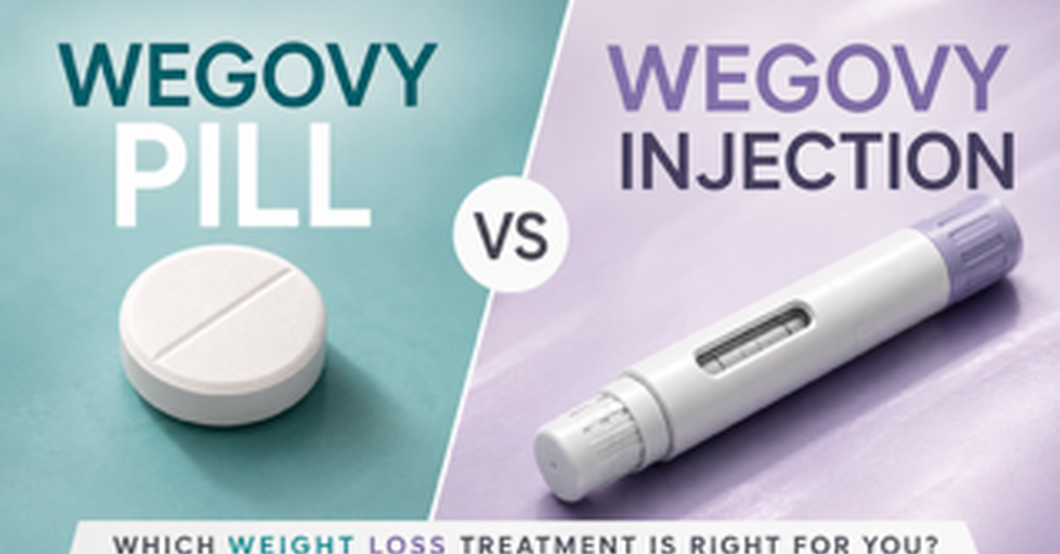
Wegovy Pill vs Wegovy Injection
One of the questions we answer almost every day at Shape⁸ is whether the Wegovy pill is better than the Wegovy injection. People often expect there to be one clear winner, but it really isn’t that simple.
Some people prefer the convenience of taking a tablet as part of their daily routine. Others like the simplicity of a once-weekly injection because they don’t have to think about medication every day. Neither option is right or wrong. The most suitable treatment depends on your medical history, your lifestyle, your preferences and, most importantly, the recommendation of your prescribing clinician.
Both contain the same active ingredient, semaglutide. Key differences are in how they're taken, dosing schedule and storage.
| Feature | Wegovy Injection | Wegovy Pill (oral tablet) |
|---|---|---|
| Form | Pre-filled pen, injected under the skin (subcutaneous) | Tablet, swallowed whole |
| Frequency | Once weekly, same day each week | Once daily |
| Starting dose | 0.25mg | 1.5mg |
| Dose titration | Increased roughly every 4 weeks: 0.25mg → 0.5mg → 1mg → 1.7mg → 2.4mg | Increased roughly every 4 weeks: 1.5mg → 4mg → 9mg → 25mg |
| Typical maintenance dose | 2.4mg weekly (a higher 7.2mg dose is also licensed for some patients) | 25mg daily |
| How it's taken | Injected into the abdomen, thigh or upper arm; injection site should be rotated each time | Swallowed whole with no more than a small sip of plain water; must not be split, crushed or chewed |
| Food and drink | No restrictions – can be taken with or without food, at any time of day | Must be taken on an empty stomach (after roughly 8 hours without food), then wait at least 30 minutes before eating, drinking anything else (including coffee) or taking other oral medicines |
| Storage (unopened) | Fridge, 2–8°C; do not freeze; keep in the original carton to protect from light | Room temperature, roughly 20–25°C; keep in the original packaging with any desiccant in place, away from moisture and humidity |
| Storage once in use | Can be kept at room temperature (up to 30°C) for up to 28 days, then must be discarded, or returned to the fridge between doses | No refrigeration needed at any point; stored at room temperature throughout, as above |
| Common side effects | Nausea, vomiting, diarrhoea, constipation, abdominal pain, indigestion, headache – most common while increasing the dose | Same gastrointestinal side effects as the injection, since it's the same active ingredient; also most common while increasing the dose |
| Other considerations | Possible injection-site reactions (redness, itching or bruising); needs a fridge, which matters for travel and holidays | No injection-site reactions or needles; effectiveness depends on sticking closely to the fasting/timing routine each day |
| May suit | People who prefer not to think about medication daily, and are comfortable with self-injecting | People who are needle-averse and can reliably build the fasting routine into their morning |
I’ve learnt that successful weight loss isn’t about choosing the treatment somebody else is using. It’s about choosing the treatment that’s right for you and that you can realistically stick with over the long term.
Who Can Be Prescribed Wegovy?
This is another question we’re asked all the time, and it’s an important one. Wegovy is a prescription-only medicine, which means it isn’t suitable for everyone. A qualified prescriber will look at factors such as your BMI, your medical history, any existing health conditions and the medicines you’re already taking before deciding whether treatment is appropriate.
I genuinely believe that’s how it should be. Weight management isn’t about buying something online and hoping for the best. It’s about understanding your health, making informed decisions and having the right support around you. That’s why every patient at Shape⁸ goes through a proper clinical assessment before any prescribing decision is made.
See if you are eligible for weight loss treatment.
The Side Effects Everyone Wants to Know About
Let’s be honest. One of the first things most people do is search for “Wegovy side effects.”
I know I did.
Like any prescription medicine, Wegovy can cause side effects, particularly when you first start treatment or increase your dose. Some people experience nausea, constipation, diarrhoea, indigestion or heartburn, while others experience very few symptoms at all. Everyone’s experience is different.
One thing I always tell people is not to compare themselves with stories they’ve read online. Forums and social media often highlight the worst experiences because people who are doing well are usually getting on with their lives rather than posting about it. If you do experience side effects that concern you or don’t improve, it’s important to speak to your prescribing clinician rather than trying to manage them on your own.
What Helped Me Most
When people ask me what made the biggest difference during my own journey, they’re often surprised that my answer isn’t the medication itself.
It was the habits I built alongside it.
I started drinking more water because I realised how often I’d mistaken thirst for hunger. I made a conscious effort to eat enough protein, even when my appetite was much lower, because I wanted to protect my muscle and keep my energy levels up. Instead of rushing meals, I slowed down and actually listened to when I felt comfortably full.
I also stopped believing that exercise had to be extreme. For years, I’d convinced myself that if I couldn’t spend hours in the gym, there was no point doing anything at all. Now I know that a walk, a swim or a short strength session all count. Consistency will always beat perfection.
The Thing Nobody Talks About Enough
If there’s one part of this journey that I think deserves more attention, it’s emotional eating.
For me, food wasn’t always about hunger.
Sometimes it was about stress.
Sometimes it was about comfort.
Sometimes it was simply habit.
After losing my son, food became one of the ways I coped with grief. I don’t think that’s unusual. Many people find themselves eating for reasons that have nothing to do with being physically hungry.
What surprised me most was that, as my appetite settled, I finally had the space to recognise those patterns. Instead of automatically reaching for food, I could stop and ask myself, “Am I actually hungry, or am I trying to soothe something else?”
That was a powerful moment in my journey, and it’s one of the reasons I always say that medication is only one part of the picture. Lasting change comes from understanding yourself, building healthier habits and giving yourself compassion along the way.
Progress, Not Perfection
One of the biggest lessons this journey has taught me is that nobody gets it right all the time. There will be birthdays, holidays, weekends away and celebrations where you eat more than you planned. There will also be weeks when the scales don’t move at all, and others where they move more slowly than you’d hoped. That’s completely normal, and it doesn’t mean you’ve failed.
For years, I believed one bad meal meant I’d ruined everything. If I slipped up, I’d tell myself I’d start again on Monday, and that cycle repeated itself over and over. Looking back, I realise that way of thinking was holding me back far more than any slice of cake ever did.
The truth is that successful weight loss isn’t about being perfect every single day. It’s about making good choices more often than not and accepting that life will always have ups and downs. One meal won’t make you healthy, just as one meal won’t undo all the progress you’ve made. What matters is what you do consistently over weeks, months and years.
That shift in mindset was one of the biggest changes I experienced. Instead of chasing perfection, I started focusing on progress. I stopped punishing myself for being human and started recognising that long-term success comes from patience, consistency and kindness towards yourself.
For me, this journey was never just about losing over four stone. It was about feeling healthier, having more energy and finding confidence again. It was about walking into a room without worrying what people thought, saying yes to photographs instead of hiding from the camera and feeling like I had my life back.
Those are the victories I value the most, and they’re the reason I always tell people that weight loss is about so much more than a number on the scales.
What I Wish I’d Known Before I Started
If I could sit down with the version of myself from ten years ago, there are so many things I’d want to say.
I’d tell her to stop blaming herself.
I’d tell her that struggling with her weight didn’t make her lazy, weak or lacking in willpower. I’d explain that living with PCOS, dealing with hormones and carrying the weight of grief all played a part in my journey. Most importantly, I’d tell her that asking for help isn’t admitting defeat. Sometimes it’s the bravest decision you’ll ever make.
For years, I believed everyone else had some secret that I didn’t. I’d watch people lose weight and wonder why I couldn’t do the same. It took me a long time to realise that everyone’s body is different, everyone’s circumstances are different and every weight-loss journey is unique. Comparing yourself to somebody else is one of the quickest ways to lose confidence.
Weight Loss Isn’t a Race
One of the biggest lessons I’ve learnt is that sustainable weight loss takes time.
We live in a world of dramatic before-and-after photographs and stories promising incredible results in just a few weeks. While those stories can be inspiring, they don’t tell the whole picture.
Real life isn’t linear.
There will be weeks when you lose weight, weeks when nothing changes and even weeks when the scales move in the wrong direction. That doesn’t mean your journey isn’t working. It simply means you’re human.
The goal shouldn’t be to lose weight as quickly as possible. The goal should be to build habits that you’ll still be following a year from now.
Building Habits That Last
When I first started, I thought success meant following a perfect plan every single day.
Now I know that’s unrealistic.
The biggest changes came from small habits that I could repeat consistently. Drinking more water, prioritising protein, planning meals, moving my body regularly and getting enough sleep all became part of my routine. None of those things felt dramatic on their own, but together they completely changed my lifestyle.
Looking back, I realise the medication supported those habits, but it didn’t replace them.
That’s an important distinction.
Medication can help create the opportunity for change, but lasting success comes from what you do with that opportunity.
Questions We're Asked Most Often
After speaking to hundreds of people considering medically supervised weight loss, I've realised that many of us have exactly the same questions.
Is the Wegovy pill better than the Wegovy injection?
There isn't a single "best" option. The right treatment depends on your health, your lifestyle and your clinician's assessment. Find out more about the Wegovy pill and Wegovy injections.
Do I still need to eat healthily while taking Wegovy?
Yes. Healthy eating, regular movement and lifestyle changes remain an important part of successful long-term weight management.
How long does it take to see results?
Everybody responds differently. Some people notice changes earlier than others, but comparing your progress with somebody else's rarely helps. Your journey should always be measured against where you started, not where someone else is today.
I've regained weight after previous diets. Does that mean I'll fail again?
No. Previous diets don't define future success. Every journey is different, and every new attempt starts with more experience than the last.
Why Support Matters
One thing I underestimated was how important support would be.
Losing weight isn’t simply about taking medication. There will be moments when you’re excited, moments when you’re frustrated and moments when you question whether you’re making progress at all.
Having someone to answer your questions, encourage you and help you stay focused makes an enormous difference.
That’s one of the reasons we built Shape⁸ the way we did.
We wanted people to feel supported from their first enquiry through to every stage of their journey, because nobody should feel as though they’re facing it alone.
My Final Thoughts
When I look back at the woman I used to be, I don’t feel disappointment.
I feel compassion.
She was doing the best she could with the knowledge she had at the time.
Today, I understand that weight is influenced by far more than simply eating too much. Hormones, medical conditions, stress, sleep, emotions and life experiences all play a role, and recognising that changed the way I viewed both myself and other people.
If you’re reading this because you’re considering medically supervised weight loss, I hope my story has given you reassurance that you’re not alone. Whether you’re exploring the Wegovy pill, the Wegovy injection or simply trying to understand your options, remember that this isn’t about chasing perfection.
It’s about improving your health, building confidence and creating a future where you feel happier in yourself.
For me, losing over four stone was an incredible achievement, but it wasn’t the greatest one.
The greatest achievement was believing in myself again.
If my story encourages even one person to stop blaming themselves and take that first step towards better health, then sharing it has been worth it.
Whatever stage you’re at, remember this: you don’t have to do it alone.
At Shape⁸, we’ll always take the time to listen, understand your goals and help you decide whether medically supervised treatment is appropriate for you. If you’re ready to start your own journey, we’d be honoured to be part of it.
| Medical information reviewed by Dr Kamran Amjed, MD - Clinical Director – Shape⁸ - 7550199 |